Purpose and People
No, not a corporate ploy, but the centre of all successful non-profits

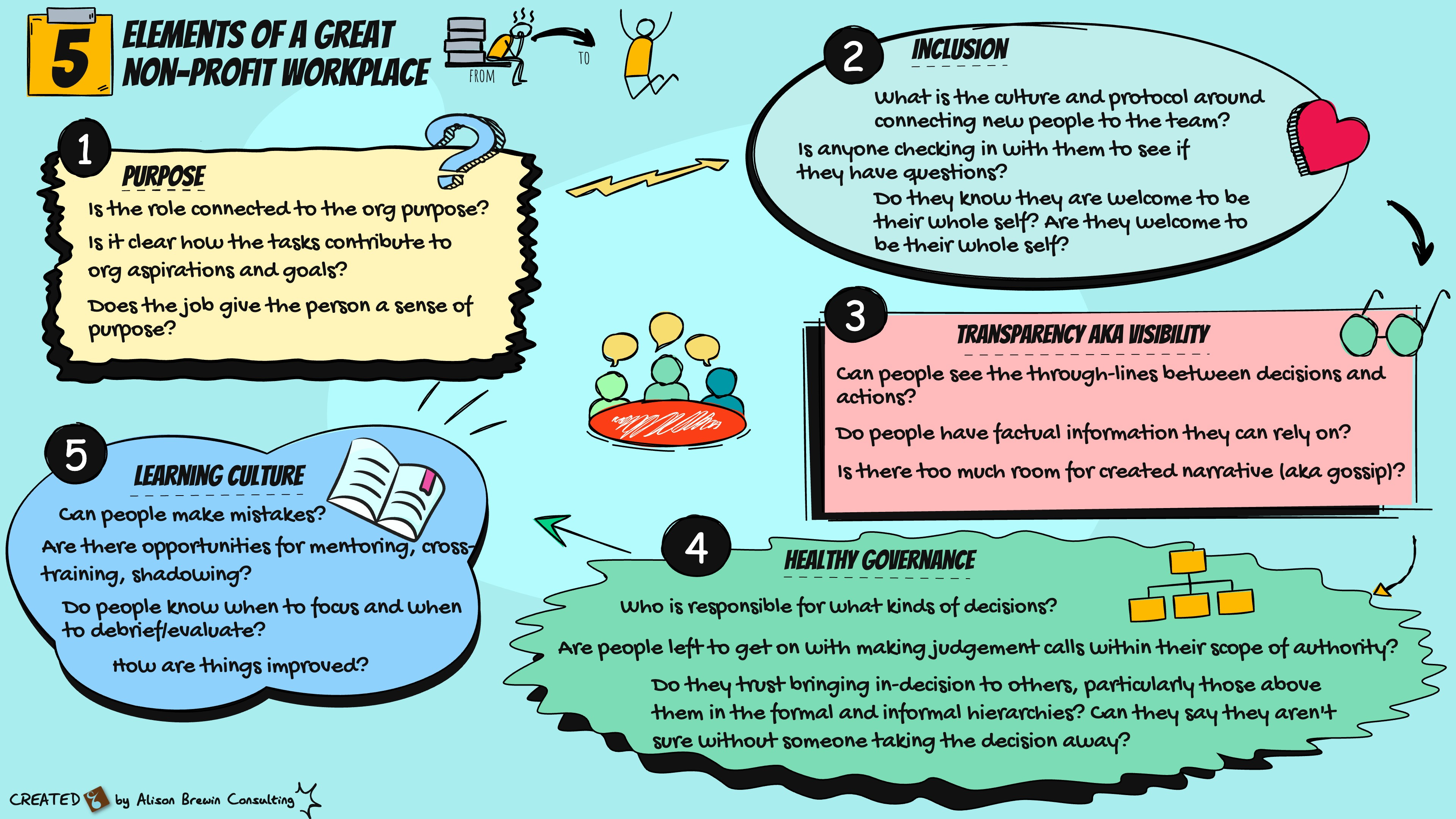
Recent news about the Canadian Immigration Museum and Oxfam UK tell us stories about why having an altruistic purpose does not save an organization from treating its people badly. In the case of the Canadian Immigration Museum, an organization dedicated to celebrating a nation of inclusion and refuge, the organization made headlines because the CEO resigned amid pretty credible evidence of a toxic and bullying leadership style. At Oxfam UK, the story seems much more complex, including tales of a CEO pushed out by a Board unwilling to confront the need to address an array of complaints about racism, a Board losing confidence in a CEO forced to make painful organizational change, and a nest of failed leadership narratives.
These are not happy stories about purpose-driven non-profits. So why is it I identify ‘purpose’ is one of the 5 elements that, if present, make a great workplace? Because you must actively make that purpose present in the work and day-to-day activities. If you don’t, it is not only possible you will end up creating an unhappy environment like the two described above, but probably inevitable.
So, what is the link between core purpose and people engagement that create places people want to be?
To paraphrase Simon Sinek from his multi-million-dollar appropriation of non-profit sector wisdom: people with a purpose are more effective, more satisfied in their lives, and less overwhelmed by the impact of corporate-colonialism. Sinek’s audience is the corporate world for the most part – explaining to private sector management that people like to know their work has impact. The message is: don’t talk about wealth generation as your core purpose, find a better way to describe it so your employees feel better about what they are doing.
Ok, I am being a tad cynical. In my defense, my career has been punctuated by moments of frustration at the invisibility of our sector and its wisdom. One of those moments occurred when I stumbled across Sinek’s work. Here was a man writing (albeit well-written and reasoned guides to getting at the ‘why’ of things) about the very thing our organizations are predicated upon. Purpose is what we do. And, as Sinek’s work clarifies, purpose eats profit for breakfast.[1]
I have always known that purpose drives humans, even though sometimes (and ONLY sometimes as it is in no way a universal reality no matter what some people tell us) the amassing of piles of dough is the purpose some choose to pursue.
It doesn’t take a rocket scientist (actually, more likely a sociologist in this case) to confirm what I have learned after years of working in this sector: the core of a non-profit’s existence as a purpose-driven entity is exactly what makes it a place people want to be. And yet, sadly, we don’t do a great job of capitalizing on that reality (see what I did there? ‘capitalizing’. Capitalism is deeply embedded in our language. I will invent a new word: ‘community-assetting’. Maybe not.) Unfortunately, that same passion is exploited by the sector and society around us to excuse low or no spending on what people need to support them in their work.
We don’t need to buy into that narrative, instead we need to double down on purpose – push the whole thing even further. Being purpose-driven doesn’t mean we don’t need money, or similarly, that we don’t generate economic activity. Being purpose-driven isn’t about having our hand out for money with a promise we won’t spend it on icky things like admin costs or infrastructure.
No, being purpose-driven means inspiring people to act. Inspiring people to offer up their talent, whether that is well-paid and supported staff roles or well-supported volunteer roles. Inspiring people to donate money, sign up as a member, or amplify the advocacy message. Inspire governments and corporations to invest in sustaining the non-profit sector.
We need to do a better job of tying our organizational purpose to our people. When we do, we attract more money, engage more people, and have more impact. It’s basic math. People + Purpose = Awesome.
Organizations that do this well are ones that live their values. Yes, it feels unfair that the standards are so high in the non-profit sector when the private sector is a hotbed of exploitation and bad behaviour. But is it actually unfair? I’m not sure. I am appalled by the stories like the Museum and Oxfam. I believe purpose-driven organizations should be held to a higher standard. But most of us are afraid to say that out loud because it becomes weaponized by donors and funders to invest in our sector even less, creating more anemic work environments that make all the important things we do more invisible and even more stressful.
However, this article is meant to offer up some of the things I have learned about how to put purpose at the centre as one of the 5 elements of a great workplace. I think it is best explained by describing how it looks like in practice.
In a non-profit that is a fabulous place to work, there are 3 things in place:
A. The purpose is described in a way that included a ‘because’ statement.
By regularly articulating the why of the why, an organization aligns its people around some core beliefs. Going beyond the basic mandate of the organization pushes important conversations about values and world views. It reminds people that there is more to it than simply a commitment to the mission and vision. In logic this is called a conditional statement that leads to predictions and deductions.
For example: I don’t know what went on internally at the Canadian Immigration Museum, but given my experience of these things, I’m willing to bet the leadership (board and senior staff) did not spend time discussing at Board meetings a statement such ‘this museum exists because we all agree that creating welcoming, inclusive spaces is something to celebrate. The logical deduction therefore, fellow Board members and CEO and other Senior leaders in this museum, we should behave in ways that are welcoming and create a sense of belonging. Therefore, our HR policies need to centre welcoming new staff and volunteers’.
This in turn leads to performance review indicators that ask managers, ‘How included do staff members feel and do they talk about being part of the Museum community? How high is there sense of belonging to a team?’
I wonder if the former CEO ever engaged the staff team in a discussion such as: ‘Canada’s First Nations welcomed newcomers and helped them manage in their new environment with remarkable generosity. What could that teach us about how we engage newcomers to the organization? What generality should we show each other as we work together?’ Or ‘This museum is all about challenging discrimination based on race. What have we done today to breakdown racism amongst ourselves? What have we learned from mistakes made in the past and how will we create ways not to repeat those mistakes going forward?’
Of course, I have no idea if these conversations happened, or if they did how they might have been applied in actions and organizational structure at the Museum. All I am saying is that if an organization makes the time for these explorations, evaluates how they are showing up, then improves things based on that, perhaps the situation would have been addressed sooner. If these are repeated conversations among the leadership, expressly explored and fully embraced, there are accountabilities and a culture that makes true bullying and harassment very, very easy to see.
B. People’s role in the organization is connected to the purpose
Non-profit board members are told their role is oversight which gets interpreted as watching the money and overseeing the ED. This is not a fun role for most people wanting to contribute to the organization’s core purpose.
The best boards understand that their role is to protect and advance the purpose. They watch the money to ensure it is achieving the organization’s purpose. Example: West Coast LEAF wasn’t doing any education work when I joined them in 1999, despite it being a part of the constitutional purpose and in the name (that’s what the ‘E’ is for). The Board ought to have been asking ‘why is there no money in the budget for education when it is a core purpose of the organization?’
And the oversight role of supervising the ED is about ensuring they aren’t leading the organization into mission creep, or in asking them (in the case of West Coast LEAF) ‘what are we doing to provide education as per our constitution?’.
If you understand this role, then you recruit board members who love the core purpose AND the purpose of a non-profit board. If they don’t, make sure that is the centre of their orientation.
And consider volunteers stuffing envelopes…ok, no volunteer stuffs envelopes anymore. Consider volunteers staffing a table for the organization at an event. Has anyone explained what the event is and why the organization has a table there? Volunteers will have a lot more fun if they aren’t terrified someone is going to ask them a hard question. Example: At a health convention of nurses, the Seniors Legal Clinic has a table. An organization that retains volunteers is one in which they are told in a situation like this: ‘We have a table there so nurses will let their senior patients know about us in case they meet seniors they suspect may be experiencing abuse. It is so important that seniors find us when they need us. You are playing a key role in making sure that happens! You aren’t there to offer any legal advice, so don’t fret, just make sure nurses know who we are and what we do.’
C. Every service/program/activity each person is involved in can be rationally connected to the organization’s core purpose
When people understand why you picked that play for the fall season, what this particular program will do to help youth find housing, or why this big gala does more than just raise money, they are excited instead of confused. Like the volunteers above who understand why you have a table at the nurses’ convention, there needs to be a sightline from what each person is doing to the core purpose.
Sure, loads of people like a basic to do list when tasked with a job. ‘Just tell me what to do’ is a phrase many a non-profit staff member has expressed, internally or externally. This is why I describe it as a sightline, not as something every person needs to have explained to them in minute, theoretical detail.
It isn’t necessary to explain in lengthy ways how each action is linked, that would be tedious and geeky (ask me how I know…cause I’ve done it, not because I was at the other end of it.) A leader’s job is to know how it is connected! If you are managing humans, you ought to be able, at the drop of a hat, to explain how item #4 on your staff member’s to-do list connects to the constitutional purpose of the organization. Invite them to ask by giving the big picture connections and encouraging them to be curious.
Let’s look at West Coast LEAF’s limited educational offerings in the 80s and 90s. What became a thriving part of the organization’s activities started by getting at why education was part of advancing women’s equality in the law. We built an amazing array of educational programming that attracted staff, volunteers, and donors. Twenty+ years later, it still involves active paid and volunteer roles in the organization. The connection was and still is this: Education advances women’s equality by (a) making sure women understand rights won so they access them and experience increased equality; (b) women understand their rights and demand them so there are improvements and opportunities to intervene in the courts; and, (c) all our work is educating courts, governments and the public about constitutional gender equality law.
And it is even better if these connections are written into job descriptions, part of work planning discussions, and mentioned in passing at every opportunity. Committee terms of reference should also be guided by them.
In summary, when these three things are present – everyone can say the full statement about why the purpose is important, roles are connected to the purpose, and activities are connected to the purpose - you will find an organization that attracts great people who work well together. This kind of leadership inspires hard work without burnout and ensures succession without panic. It also creates organizational resilience more effectively than an operating reserve. I promise. (See some future article on how to build and use operating reserves because they are important, just not as important as this stuff!)
Next week: How practising inclusion is central to great people engagement.
[1] Reference to another corporate guru who said ‘Strategy eats culture for breakfast’ meaning it doesn’t matter how excellent your strategic plans are if your organization’s culture is bad. I am culturally appropriating corporate culture here to laugh in their faces – bwahaha – to emphasize that having purpose is more important than making a profit and that addressing purpose first will make profits (social, economic, environmental, artistic etc.) possible.