Consensus Decision-Making
Not the opposite of Robert’s Rules but an alternative to majority rules.

‘Coming to consensus’ or ‘Looks like we have consensus’ are words you have probably heard somewhere in your life as a person who goes to work meetings in North America. It has become a signal of informality and uniformity, a kind of ‘we have no need to revert to the formal voting of Robert’s Rules because we are of one mind’. While it may be just that - an acknowledgement that everyone is on the same page at the end of a discussion - it is not a euphemism for no conflict, nor should it be lightly treated.
Like any systems or frameworks, it is applied by individuals functioning within the power dynamics of the world we live in. Consciously or unconsciously, it can result in replicating intricate and contextual power dynamics, or it can break them down. Just as Robert’s Rules were written to protect democracy and ensure fairness, so to consensus decision-making is intended to support equity and inclusion. When applied well, it does just that!
Using a consensus model isn’t the opposite of Robert’s Rules - a kind of informal, ant-colonial antidote to the formal, stodgy nature of good-old Henry Robert’s intricate homage to colonial systems of democracy. It is, however, an alternative approach to majority rules inherent in Robert’s Rules. Consensus approaches are focused specifically on the part of the meeting in which a decision needs to be made. It doesn’t delve into the details of agenda-setting and minute-taking as other rules do, but it provides a framework for managing conflict and engaging that conflict for the benefit of the organization.
It takes commitment, integrity and mutual respect. Practicing consensus is an acknowledgement that the organization will be best served if those with authority over decisions navigate the conflict together and come to an aligned decision before anyone acts on it.
But even the most dedicated collective can get it wrong, because it requires a number of things to be in place as well as strong facilitation or ‘hosting’. It also requires calrity on the idea of conflict over ideas as a good thing, conflict between personalities is not so great or useful. I have been part of feminist collectives in the past and I can tell you, when people start making things personal without accountability to the needs of the organization, no meeting rules are going to resolve the conflict in the room.
Another common misuse of consensus is when a group to has a tacit – or outright – commitment to try for consensus but happy to revert to a majority vote if it doesn’t work out. The scenario of ‘if things get sticky, let’s call for a show of hands and the majority will prevail’ which can also give people permission not to try to hard. This is very problematic and a good argument to simply stick with Robert’s Rules (RRO) in its entirety. Because at least with RRO everyone has clarity on when the matter will be voted on. In fact, RRO has rules allowing any member of the group to ‘call the vote’ which empowers members to take some control over the discussion and not wait for the chair to notice!
In the situation where the group is still not in consensus it can feel very arbitrary when the Chair says ‘Enough! We aren’t reaching consensus so now we are going to vote.’ The result is an increase in frustration and unresolved conflict.
So, how do you do consensus well? What are the key elements and the steps for managing it?
First, Alison Brewin’s checklist for the soil that best suits the growth of true consensus decision-making in any given team, then some steps for making it happen.
Elements required for higher likelihood for successful use of consensus:
1. Clarity in the meeting about what the decision it is that needs to be made – preferably in advance of the meeting, or take the time to agree on what the decision is in the meeting.
2. Ground rules/‘Community Agreement’/code of conduct – Some kind of statement everyone has agreed to about what constitutes unacceptable behaviour and/or what is ‘good’ behaviour. I like concepts like ‘listen when others are speaking”, and ‘devices off while process is underway unless we all agree to look something up’, or ‘critique the idea, never the person’. I am a bit of a cryer when I am frustrated, so I am a fan of something like: ‘emotions are welcome’.
3. Clarity that this team has the authority to make this decision – Don’t use consensus if the truth is that one person actually has the authority to make the decision. If, for example, an executive director chooses to use consensus in staff meetings, the decisions they bring to the staff meeting are no longer under their authority! Consensus is not consultation!!
4. Information and evidence required to make an informed decision is available – you can’t force grown-ups to read articles or watch videos, and if someone hasn’t reviewed the material in advance they need to be transparent about that in the meeting. At least ensure everyone could access the material. If they didn’t review it because they didnt make it a priority, that is one thing, but if they couldn’t access it when they tried, that is another. Are there members in the group who may have struggled with the language usage (lingo, English, acronyms etc.)? Was it a video that required certain software to watch? Are their members with abilities or challenges that need accommodating (visual capacity, neurodiversity, hearing etc.)?
5. Be in-your-face about the overarching purpose and strategic aspirations of the group aka context matters – Does everyone know what the vison/mission/mandate of the organization is and what the overarching goals are? What is the context of this decision? Is everyone aligned around the core purpose of your coming together?
6. Willingness to take the time it takes – I believe in being up front with people about how much time you are asking of them and not taking much more than that. It isn’t just my ADHD that makes me HATE meetings that seem to have no end - its also my parental identity, my belief that there are fun things in the world that aren’t about being in meetings, and, well, my ADHD). Consensus takes time!! It takes more time than our busy-obsessed world often allows for. For me, the balance is having regular meetings planned – more meetings, but always with an overarching time limit. I.e. every second Tuesday of the month for 2 hours. If one topic takes up the whole meeting, then you know you can take the other topics to the next meeting. If you don’t have one planned everyone has to descend into doodle-poll hell.
7. Learning and evaluation culture – Are you prepared, as a group, to try things and make time to debrief or share ideas about how to improve something? No one gets everything right the first time and a culture that encourages supportive feedback, where everyone truly believes people are trying their best, allows for the effective exploration of alternatives to the norm, like using consensus rather than majority votes. It builds trust in a group if everyone can share ideas for strengthening their work together. The key is put time aside for it. A learning culture is NOT an environment in which everyone gets to tell everyone else what they are doing wrong!
In terms of that last point, I believe that consensus decision-making is good for non-profit boards because it also forces the baord to be clear about what are, in fact, high-level governance decisions and what can be left to the staff to work out. Because consensus requires you to focus on the important decisions, the group begins to see which topics they debate and discuss ad nauseum are, in fact, not a big deal. You are forced to prioritize because you have to decide together if this is something worth putting time into! Eventually, the group gets very good at saying ‘this is an important decision for the organization so let’s make absolute sure we are in consensus’ and avoid those ones that are more ‘Francesca is going to oppose this thing because she always does, but the rest of us are really clear and, oh, will you look at that, it technically is an operational matter so instead of letting Francesca make us spend half the meeting on it, let’s just let the ED decide’. (entirely fictional as the Francesca who was on my board years ago is super smart and always had a good reason for wanting to talk something through!)
Here is a summary of the key steps to follow in a meeting to achieve consensus, (see the excellent tool developed by Ontario’s Tamarack Institute, link below):
1. An idea is raised: can be determined in advance by agenda setters, proposed (or amended) by a member of the group, or arise as a result of discussion in the meeting.
2. The facilitator allows for discussion of the topic, ensuring that everyone has a chance to share their thoughts.
3. A proposed question is framed by the group – again, might be done in advance. It might be ‘We could do one of these 2 or three things’ or in the form of a question ‘Should we…?’ (whiteboards, flip charts, or virtual whiteboards helpful here)
4. Everyone has a chance to say where they are on the question:
a. Either a ‘poll’ in which people, at the same time, say whether they support, oppose, or unsure (thumb up, down or sideways) in the case of a question, or hold fingers up to show which option they support in the case of some options having been offered.
b. Go around to each person and have them say where they are and why.
5. If consensus is achieved than badaboom, all good.
6. If not, go around and let each person share their thoughts about what they are thinking, what they could live with, or what would be needed for them to change their mind. A good question to ask each person to comment on is ‘What would you need to take a different the position?’
7. Then do another poll, but this time people can use a symbol that means ‘I can live with either option.’
8. Keep going around letting each person speak, then doing a poll, until you either achieve consensus or you have pinned down the thing that is holding back consensus (i.e. not enough/right info? Concerns about impact on some people not represented in the room? Concern about who has authority over the decision itself?)
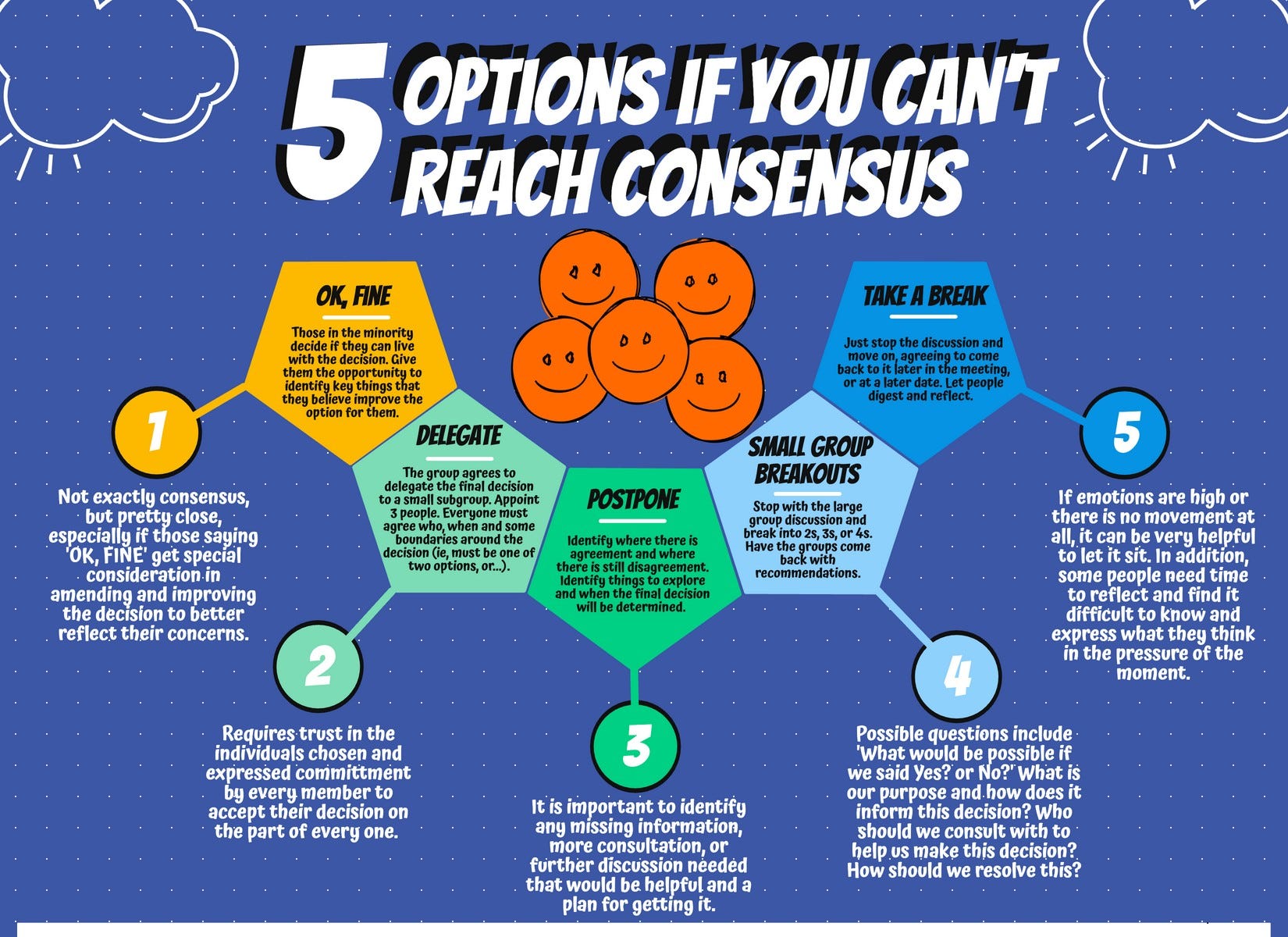
If you can’t achieve consensus, I believe there are five possible options, one of which is to decide to go ahead with a vote and accept the majority. See the infographic below for the five options I recommend. The internal loopiness of consensus decision-making is, of course, that the decision as to how to address the lack of consensus does need to be a consensus decision! But it can be done!
Conclusion
Consensus decision-making isn’t easy. It takes a willingness to try, and practice. Like all meeting ‘rules’ it is best achieved when everyone in the group has consented to use this approach and has been offered an opportunity to understand how it works. And it is successful where the team genuinely trusts each other to have the best interests of the organization front and centre. I’m a fan but know very well that it isn’t always the best choice for every group.
Fabulous resources to help make the switch from majority rule to consensus:
1) Tamarack Guide to consensus decision-making. Link up to date Oct 13, 2025
2) Deep Democracy is a highly valuable approach to diving into conflict and truly respecting and uplifting minority opinions. A way to break down power dynamics that gets beyond the deeply held cultural norm that perpetuates an idea that ‘majority rules’ is fair, effective and efficient. (The ‘efficiency’ of majority rules is severely undermined by the continued frustration of the unheard minority, not to mention the inequities perpetuated etc.) – Multiple sources, google ‘Lewis Deep Democracy’.
3) Social Change Library has a good guide. Link accessed Oct 13th, 2025.
4) I really like this one by Barbara MacKay, Founder of North Star Facilitators. I was able to find it for free, but out of respect for facilitators making a living, I purchased it for $30 and direct you to the paywall: https://north-star-online.thinkific.com/courses/consensus-and-decisions
Have you ever tried consent decision making? In my experience, it works very well for boards, because board members per definition have different backgrounds and perspectives. Consensus can then be very hard to reach.
https://www.sociocracyforall.org/consent-decision-making/